
Breathing in your essential oils: why olfaction works fast
Abyss Glass
There is something almost magical about breathing in a scent and feeling your state change within a few seconds. A breath of lavender and your shoulders relax; a hint of mint and your mind wakes up. It is not just an impression: of all the ways to use essential oils, breathing them in, olfaction, is the fastest-acting, the gentlest, and the simplest to fit into everyday life. Here is why the nose has this power, and how to breathe in your essential oils to get the best out of them, wherever you are.
What does breathing in an essential oil mean?
There are three main ways to use an essential oil: swallowing it (oral route), applying it diluted to the skin (skin route), or simply breathing it in (olfactory route). The last one consists of bringing the scent to within a few centimeters of your nose and inhaling, without ingesting anything, without spreading anything.
It is the most accessible and least risky use of essential oils, and it is what olfactotherapy is all about. But beyond its simplicity, breathing has an advantage that the other routes do not have: speed.
Why olfaction is the fastest route
To understand, you have to follow the path of an odor molecule. When you breathe in an essential oil, its highly volatile aromatic compounds rise up into the nose and meet an area of sensors located at the very top of the nasal cavities. These sensors turn the odor into a nerve signal.
And that is where it all happens: this signal travels almost directly to the limbic system, the region of the brain that manages emotions and memory. Unlike our other senses, smell has almost no intermediary between the sensor and the emotional brain. It is a shortcut.
Compare this with the other routes: an oil that is swallowed has to be digested, an oil applied to the skin has to pass through several layers before taking effect. Breathing, on the other hand, bypasses all of that. This is why a scent can, in a fraction of a second, bring back an entire childhood memory or shift your mood. And that is exactly what you are looking for when you want to calm down before a meeting or get back on your feet at 3 pm.

What breathing in an essential oil can bring you
Breathing does not heal and does not replace any medical follow-up: it is a well-being practice that accompanies how you feel in the moment. Used regularly, olfaction can help you:
- release the pressure before a tense moment, with a few mindful breaths of a gentle scent;
- regain momentum during a dip in energy, with fresh, lively notes;
- refocus after an interruption, to get back into your task;
- create a reassuring ritual, by associating a scent with a state of mind you want to return to.
The idea is not to "take" an oil like a medicine, but to treat yourself to a sensory pause, at the right moment, as often as you feel the need.

How to breathe in your essential oils, in practice
The beauty of olfaction is that it requires almost nothing. Several supports exist, from the most makeshift to the most refined:
- From the bottle: you unscrew it and breathe in a few centimeters away. Handy for testing a scent, less so for the whole day.
- On a handkerchief, one to two drops, which you then breathe in. Simple, but it evaporates quickly and gets lost. We detail this method in our article on dry inhalation.
- With an aroma stick, a small portable tube to breathe from, discreet and functional.
- With olfactotherapy jewelry, a pendant that holds a few drops and keeps the scent close to you all day, with nothing to take out.
If you don't have a diffuser or you are on the move, we have gathered all the options in our guide using essential oils without a diffuser.
Which essential oils to breathe in to get started
To start, it is best to choose oils that are gentle, versatile and pleasant to the nose:
- Sweet orange or true lavender, reputed to be soothing, ideal for releasing the pressure;
- Peppermint or lemon, fresh and invigorating, for a pick-me-up;
- Ylang-ylang, to rebalance your mood;
- Eucalyptus globulus, for respiratory comfort in the cold season.
Precaution: even when inhaled, some essential oils, including peppermint and eucalyptus, are not recommended for pregnant or breastfeeding women, young children and people with epilepsy. Stick to gentle, occasional olfaction, always check the contraindications specific to each oil, and ask a healthcare professional for advice if in doubt.
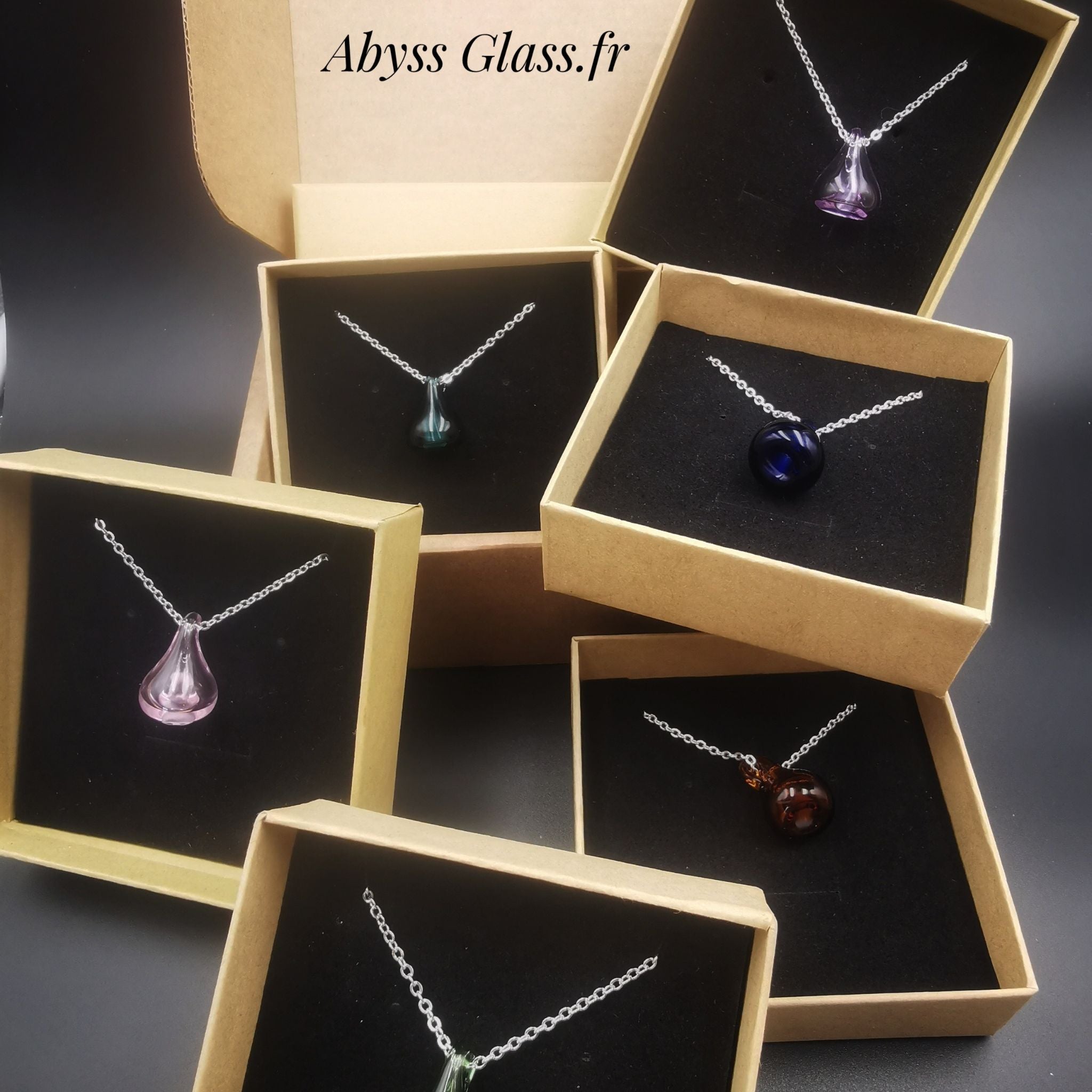
Keeping your scent within reach of your nose: olfactotherapy jewelry
If olfaction works within a few seconds, you still need to have your scent with you at the moment you need it. That is exactly the idea behind the Abyss Glass olfactotherapy® pendant: you place a few drops of your favorite essential oil in it using a dropper, and the scent accompanies your day for several days. No bottle to take out, no handkerchief to look for: just bring the piece of jewelry to your nose and breathe.
Each pendant is flameworked, by hand, in a workshop in the Hautes-Pyrénées, a one-of-a-kind piece that is as much a piece of jewelry as a well-being object. To get started with everything you need, the olfactotherapy® gift box brings together the piece of jewelry, an essential oil of your choice, a dropper and a booklet. Discover the olfactotherapy pendants →
Frequently asked questions
Is breathing in an essential oil really effective?
For a quick well-being effect, calm, a boost of energy, refocusing, yes: olfaction is the most direct route to the emotional brain. It is not meant to heal, but to accompany how you feel in the moment.
Why does olfaction work faster than the skin or oral route?
Because it bypasses digestion and the skin barrier: the odor signal reaches the limbic system almost directly, without any intermediary. That is what makes the effect almost immediate.
How many times a day can you breathe in an essential oil?
For gentle olfaction, there is no strict rule: you breathe in your scent when you feel the need. Pay attention to the precautions specific to each oil and avoid prolonged, repeated use without advice.
Do you need to dilute an essential oil to breathe it in?
No: for olfaction, you breathe in the scent as it is, at a distance. Dilution in a vegetable oil only concerns application to the skin.
This article is intended as well-being information and does not constitute medical advice. Essential oils must be used with care; if in doubt, consult a healthcare professional.


